Honda Aircraft Company Successfully Conducts First Flight of Ultralight Business Jet Using 100% SAF

6 Nov 2025

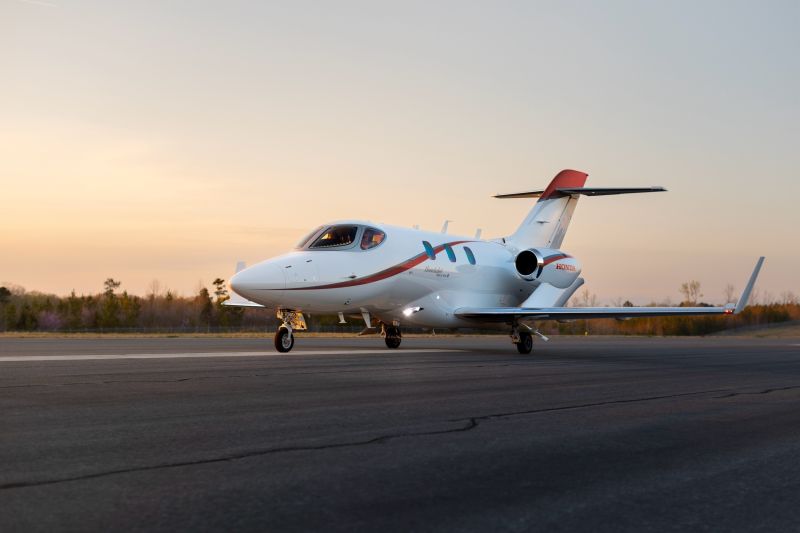
GREENSBORO, NC, October, 2025 – Honda Aircraft Company announced that it has become the first twin-engine ultralight business jet manufacturer to successfully conduct a flight of the HondaJet using a 100% sustainable aviation fuel (SAF) blend.

The flight, conducted with a production HondaJet, used a combination of synthetic paraffinic kerosene with hydroprocessed esters and fatty acids (HEFA-SPK) and hydrodeoxygenated synthetic aromatic kerosene (HDO-SAK). The aircraft circled the Greensboro area before landing successfully at the company’s world headquarters at Piedmont Triad International Airport. This achievement was made possible through the collaborative work of engineers from Honda Aircraft Company and GE Honda Aero Engines, the company responsible for designing the HF120 engines that power the HondaJet.

Currently, HondaJets in service operate with approved SAF blends of up to 50%, but GE Honda Aero completed ground testing of the HF120 engine in 2022 and 2023 using 100% synthetic blends, laying the groundwork for this historic flight. “We are immensely proud of our team for demonstrating that the HondaJet is capable of operating on a 100% SAF blend,” said Amod Kelkar, senior vice president and chief commercial officer of Honda Aircraft Company. “This achievement represents another step toward aligning our activities with Honda’s global goal of decarbonizing our operations by 2050.”

Thanks to its design focused on maintaining laminar flow throughout the aircraft, the HondaJet offers up to a 20% improvement in fuel consumption compared to similarly sized aircraft. In 2024, Honda Aircraft Company earned Sustainable Flight Department accreditation from the National Business Aviation Association (NBAA), reinforcing its leadership in efficiency and sustainability within the industry.

Source and Credits to Honda Aircraft 

For more information click <<Here>>
The best investment opportunities in aviation are Carbon Free

Get the latest news, analysis, and opportunities straight to your inbox.

We don’t spam! Read our privacy policy for more info.

The best investment opportunities in aviation are Carbon Free

Get the latest news, analysis, and opportunities straight to your inbox.

We don’t spam! Read our privacy policy for more info.

Archer Aviation stocks fall after Q4 2025 financial results

Archer Aviation stocks fall after Q4 2025 financial results By Nicole Suárez, Carbon Free Aviation JournalistMarch 2026 Archer Aviation published on March 2 its fourth-quarter and full-year 2025 financial results, reporting a record liquidity position alongside one of the company’s most significant regulatory milestones, becoming the first electric vertical take-off and landing (eVTOL) manufacturer to achieve full Federal Aviation Administration (FAA) acceptance of its aircraft’s Means of Compliance. Despite the milestone, Archer’s stock dropped 4.3%

Read More »

Sarla Aviation advances structural validation and flight test preparation while expanding its engineering team

Sarla Aviation advances structural validation and flight test preparation while expanding its engineering team 5 March 2026 The aerospace company Sarla Aviation, based in India, announced continued progress in a critical phase of aircraft development as it prepares for upcoming validation activities and flight test campaigns. According to the company, aviation capability is not built through headlines alone, but through extensive work in laboratories, hangars, engineering reports, and flight campaigns. Sarla Aviation’s engineering teams are

Read More »

FAA launches new U.S. air traffic control system with 2028 implementation target

FAA launches new U.S. air traffic control system with 2028 implementation target 5 March 2026 The Federal Aviation Administration (FAA) and the United States Department of Transportation (DOT) have announced an ambitious initiative to fully modernize the United States air traffic control (ATC) system, aiming to improve safety, reduce delays, and prepare the infrastructure for the future of aviation. The program will replace critical infrastructure such as radar systems, software, hardware, and telecommunications networks, creating

Read More »