Who makes the electric motors that will power eVTOLs
By Nicole Suárez, Carbon Free Aviation Journalist
13 March 2026
As electric vertical takeoff and landing aircraft (eVTOLs) move closer to commercial service and become an increasingly important feature of future urban air mobility, the industry must adjust not only to regulatory approvals and infrastructure planning but also to manufacturers building the core components that power these aircraft, such as electric motors.
Unlike gas turbines or piston engines in traditional aircraft, eVTOL propulsion depends on compact, powerful, and highly reliable electric drive systems designed specifically for aerospace applications. And even though these motors are central to performance, safety, and certification, most people barely hear of the companies that make them.
Why are electric motors important for eVTOLs?
Electric motors are among the most critical components for eVTOLs. According to Huaci Technologies, a Chinese motor core manufacturer, these motors must deliver high power density and reliability while minimizing weight, a more difficult engineering challenge than for automotive or industrial motors.
Likewise, unlike in those sectors, aerospace electric motors must meet rigid certification requirements and performance margins before regulators will approve an air taxi for passenger service. As a result, eVTOL OEMs (Original Equipment Manufacturers) rarely design these motors in-house. Instead, they partner with specialized suppliers whose technology meets the demanding requirements of aviation.
There are several motor supplier companies
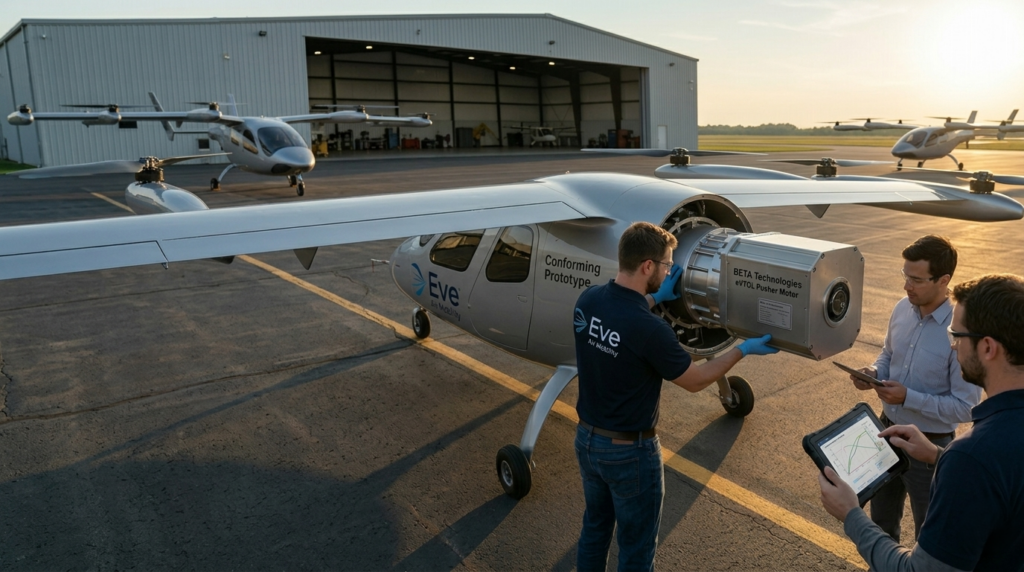
Currently, one of the most prominent examples is BETA Technologies, a United States-based electric aircraft developer that also builds electric motors. In December of 2025, Eve Air Mobility, a subsidiary of Embraer’s urban air mobility division, selected BETA Technologies as the supplier of the electric pusher motors for its conforming prototypes and production aircraft.
According to an Eve Air Mobility press release, this collaboration will strengthen its supply chain as it represents a potential 10-year, up to USD $1 billion opportunity for BETA, and includes an initial evaluation in which BETA’s motors will be used in Eve’s engineering prototype ahead of its expected first flight in late 2025 or early 2026.

By sourcing proven electric motor technology rather than building from scratch, Eve aims to reduce risk and accelerate entry into service.
There are other suppliers as well, such as Evolito Ltd. This British company, which spun out of electric motor pioneer YASA, develops high-performance, lightweight axial-flux electric motors and battery systems specifically for the electric aviation market.
In early February, Vertical Aerospace, an aerospace and technology company pioneering electric aviation, selected Evolito as the electric engine partner for its Valo eVTOL aircraft.
According to an Evolito article, this partnership involves jointly certifying Evolito’s electric propulsion units with the UK Civil Aviation Authority (CAA) and the European Union Aviation Safety Agency (EASA) as part of Valo’s path to commercial service.
Beyond these examples, many other eVTOL developers collaborate with established propulsion suppliers to design and test electric motors for their aircraft. Motor suppliers will be essential to managing risk, ensuring performance, and achieving certification as eVTOL programs progress toward production and commercial service.