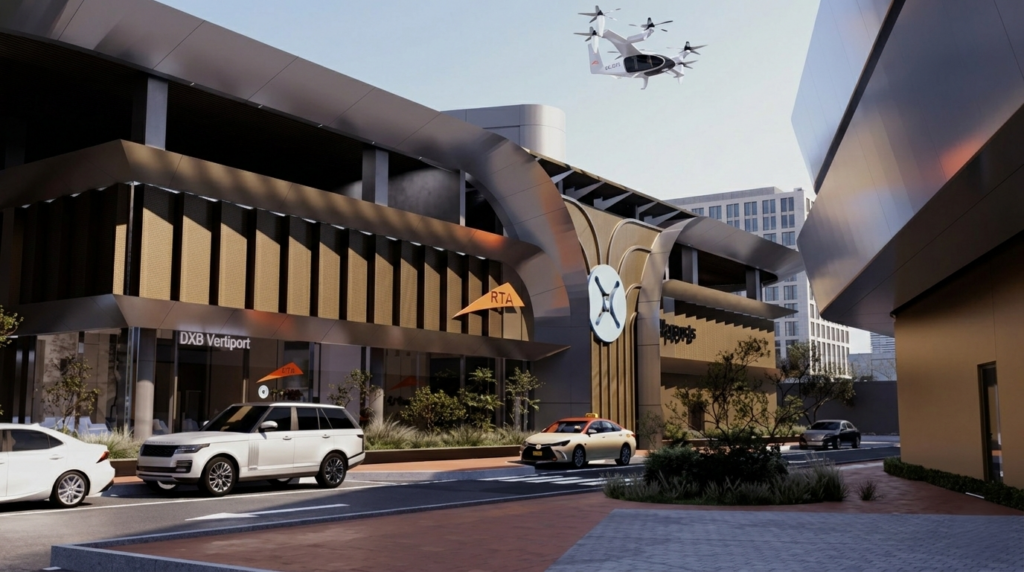
UAE at the forefront of building commercial vertiports
By Nicole Suárez, Carbon Free Aviation Journalist
3 March 2026
While manufacturers continue to make progress in certification, the infrastructure for electric vertical takeoff and landing (eVTOL) aircraft remains one of the most crucial factors in moving closer to commercial service. Worldwide, governments, developers, and aerospace companies, such as Skyports Infrastructure, SkyDrive, and Joby Aviation, have already begun developing vertiports.
What is a vertiport?
The infrastructure needed for the proper functioning of eVTOLs is called vetiport. Vertiports are the designated structures that support where eVTOLs land, park, and store, as defined by the U.S. Federal Aviation Administration (FAA). These facilities are equipped with charging stations, passenger areas, air traffic support, and often automated systems to manage high-frequency takeoffs and landings.
According to a 2025 PwC report, over 1,500 vertiports have been planned for construction globally between 2025 and 2030, with significant activity concentrated in Europe and AsiaPacific. (Read more about it on our website) Still, there’s quite a difference between planning and construction, but some progress has been made in the last few years as the industry transitions from just concept to real commitment.
Vertiports in action: Where projects are advancing
Among the clearest examples of physical progress is in the United Arab Emirates. For instance, the London-based leader vertiport developer, Skyports Infrastructure, in partnership with the Dubai Roads and Transport Authority (RTA), began construction on a network of commercial vertiports tied to Joby’s planned air taxi launch in the emirate in 2024.
One of the projects in motion is Dubai’s first commercial vertiport, “DVX”, next to Dubai International Airport. In late 2025, Skyports announced that its DVX vertiport was 60% complete, with construction running on schedule for planned completion for Q1 2026.
The UAE’s vertiport regulations and government-backed planning demonstrate how forward-leaning policies can accelerate infrastructure readiness ahead of commercial service launch. In contrast, the progress in western markets where regulatory systems are still fragmented has been slower but not non-existent.
In the UK, Skyports is also building one of the country’s first testing grounds and hubs for eVTOLs. Its vertiport at Bicester Motion, Oxfordshire, as it was stated by the company, reached operational completion in mid 2025.
In the U.S. case, infrastructure deployment has largely focused on adapting existing transportation facilities. For example, Joby announced in late 2025 a partnership with Metropolis Technologies, a parking infrastructure and AI technology company, to develop 25 vertiport sites across the country.
Also in early 2025, Osaka Metro Co., Ltd., the operator of Osaka’s subway network, completed the OSAKAKO Vertiport in Osaka, Japan. The facility is among the first purpose-built vertiports in the country and has already hosted demonstration flights of the SkyDrive SD-05, produced by Tokyo-based startup SkyDrive Inc.
Infrastructure is becoming tangible
Vertiports are more than just facilities; they determine when and where commercial operations can realistically begin. For investors watching the sector, the ongoing progress in the construction of these vertiports may become a clear sign of viability in the eVTOL industry.
Across Asia, North America, the Middle East, and Europe, vertiports are being planned or in the process of being built, and several companies such as Skyports are already delivering physical facilities.