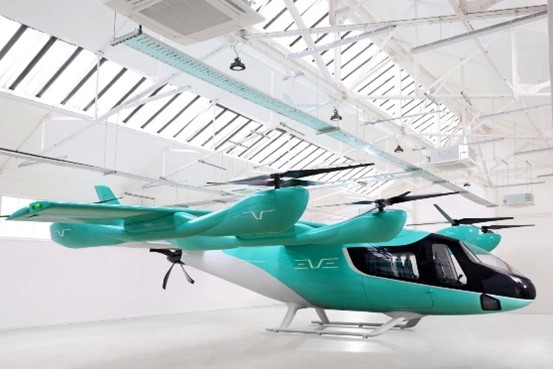
The sky is no longer the limit: The new world is taking off with eVTOLs
July 14 2025, by Samuel Herrera, Carbon Free Aviation Journalist
Imagine opening the window of your room in an eco-friendly resort in Costa Rica and seeing an electric drone silently cruising the sky, transporting travelers minutes away, and now let’s go to the other side of the world, in an Asian city where dozens of these aircraft take off in perfect synchrony, or perhaps in a suburban village in the United States where shopping or getting to a hospital for an emergency takes less time than it takes to make a cup of coffee.
What seems like a scene out of science fiction is today no longer a promise but the next great revolution in human transportation.
And it’s not just a technological leap, it’s an emotional, social and ecological leap, one that redefines what it means to move, to live, and to change the planet.
The course of the world has the same destination: flying cleaner
In Costa Rica, an electric air transport network is being built to connect airports, hotels and nature reserves in the region. Eve Air Mobility, Aerosolutions and Bluenest by Globalvia signed an agreement to introduce 50 eVTOLs along with infrastructure and services that will transform how tourism is experienced.
And this is not a matter of just one region, the world is changing, as in China, an alliance was created so that by 2030, more than 100 companies will develop eVTOLs, and it is not a loose idea, it is a strategic plan of a power that has already crossed the barrier of commercial operation with these vehicles.
And the United States has companies such as Joby Aviation and Archer that are leading a race to put electric cabs in the air that can reduce noise, cut times and compete on a global scale, and they already have dates set and it is just around the corner, the Los Angeles Olympic Games 2028 will be their great showcase.
The eVTOLs are electric aircraft capable of taking off and landing vertically, like a helicopter, but silent, like an airplane, but without runways, they can take you from an airport to your hotel, from a medical center to your home or from a congested neighborhood to a rural area and all that, in minutes and without emitting a drop of carbon.
They don’t need runways or big infrastructure, just air as the road and open skies as the landscape, and you get a new way of thinking about transportation.
And that is exactly what they are doing, in different countries, from different angles, but with the same objective, that flying stops being a privilege and becomes a daily, ecological and efficient option.
That’s where Eve comes in, with a fleet of eVTOLs designed to connect destinations in a sustainable way, the alliance with Bluenest includes the development of vertiports that will allow take-off from the same airport and landing near a nature reserve, without altering the environment.
And while Aerosolutions leads the operation of the flights, Eve provides its “TechCare” suite to guarantee maintenance, pilot training and user service, all on the same platform, all designed to make the experience not only fast, but perfect.
What China did with electric cars, it is now repeating, China Low Altitude Economic Alliance (CLAEA) is the epicenter of a plan that foresees the creation of more than 100 active eVTOL companies before the end of this decade.
This expansion is not spontaneous, it is a symphony between engineers, legislators and entrepreneurs, it is the example of how a country can look to the sky and say: “there is also room to lead”.
In the U.S., the focus has been clear, “demonstrate that eVTOL flying is safe, viable and attractive,” Joby Aviation has already completed over 40,000 miles of testing with an aircraft capable of flying 100 miles at 200 mph and the next step? Full autonomy. They are already integrating pilotless flight systems after acquiring Xwing Inc, pioneers in autonomous aviation.
Archer, meanwhile, will not only be the official airlift provider for the 2028 Los Angeles Olympics and Paralympics, but is also working with the military industry to bring eVTOLs to new missions.
Both companies are in competition with each other, but that competition is driving innovation, investment and efficiency.
Humanity needs to move forward without destroying, to move without slowing down the planet, and all this has a solution in the air. eVTOLs are not just electric vehicles, they are a promise, a promise not to repeat the mistakes of the past in a world that can no longer afford to pollute in order to progress.
Today they are projects, tests, agreements, tomorrow they will be regular routes, mobile applications, platforms and destinations within reach of a silent flight, the future has already taken off, and is waiting for you to do it too.