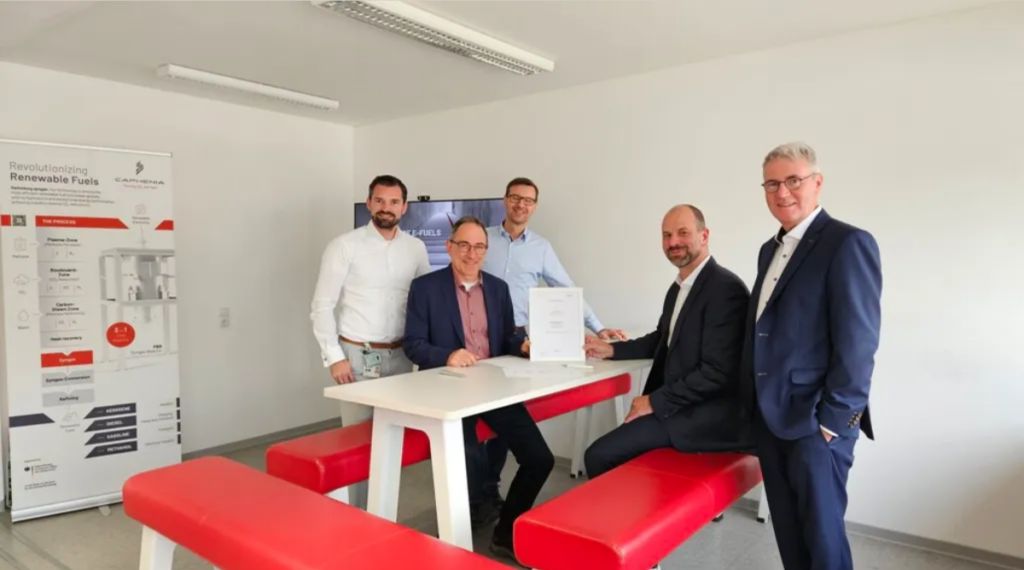
Siemens and CAPHENIA Sign Alliance to Accelerate Global Sustainable Aviation Fuel (SAF) Production
26 Feb 2026
Siemens and CAPHENIA have signed a strategic alliance to accelerate the industrial scale-up of Sustainable Aviation Fuel (SAF), aiming to drive the energy transition in the aviation sector.
As part of the agreement, Siemens becomes the preferred partner in automation and digitalization, providing technological solutions for CAPHENIA’s innovative plasma technology, capable of converting biomethane into synthesis gas, a raw material for producing SAF, renewable diesel, and chemicals.
Highly Energy-Efficient Plasma Technology
The core of the process is the Boudouard Plasma Reactor (PBR), a unique “3-in-1 zone” system that integrates three chemical reactions in a single reactor. The technology decomposes biomethane at approximately 1,500 °C, generating synthesis gas that can be transformed into synthetic fuels with no byproducts and minimal energy losses.
One of the system’s key differentiators is its efficiency of over 86%, achieved by reusing the heat released during gas cooling to preheat the incoming biomethane. This performance significantly surpasses conventional production methods.
Digitalization as a driver of scalability
Through its Siemens Xcelerator portfolio, the company will contribute process control systems, drive technology, instrumentation, simulation software, and digital twins. These tools will enable the optimization of operating parameters before physical commissioning and ensure standardized processes across multiple installations.
The support extends from CAPHENIA’s pilot plant in the Höchst Industrial Park in Frankfurt to future commercial expansion. The goal is to develop a modular and standardized automation and digitalization framework for the PBR, facilitating faster global implementation and reducing commissioning times.
A rapidly expanding market
Demand for SAF is growing, driven by regulations such as the European Union’s Renewable Energy Directive (RED), which establishes mandatory blending quotas. It is estimated that by 2050 the global aviation industry will need around 500 million tons of SAF per year, while currently it represents less than 1% of global kerosene consumption.
In this context, the alliance between Siemens and CAPHENIA aims to position itself as a technological catalyst to close the gap between supply and demand, accelerating the industrial production of sustainable synthetic fuels.
Source and Credits to Siemens
For more information click Here