Europe Will Need Large Volumes of Renewable Electricity to Fulfill Its e-SAF Plans, Warns IATA
16 Feb 2026
The International Air Transport Association (IATA) has highlighted the enormous energy challenge posed by the development of e-SAF in Europe, emphasizing that the availability and cost of renewable electricity will be key factors in the strategy’s success.
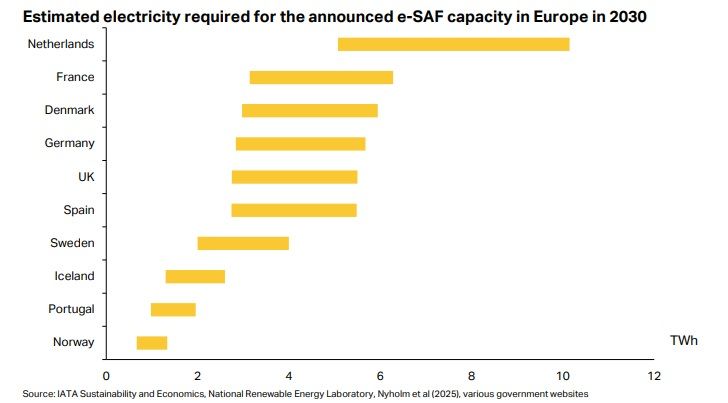
e-SAF, a synthetic fuel produced from green hydrogen and captured CO₂ using renewable electricity, requires between 20 and 40 MWh per ton produced. According to currently announced plans, European countries will need between 0.7 and 10 TWh of electricity to support the planned projects.
Europe plans to build more than 1.5 million tons (Mt) of e-SAF capacity by 2030, which would represent approximately 80% of the projected global capacity for that year.
However, the challenge expands significantly by 2050. For airlines to achieve the global goal of net-zero emissions, it is estimated that around 205 million tons of e-SAF will be needed.
The optimal location for producing this fuel will depend on regions where renewable electricity can be generated in abundance and at competitive prices. In this context, Europe faces the risk that renewable capacity will not grow at the necessary rate or that energy costs will hinder the economic viability of projects.
The development of e-SAF represents not only a technological and industrial challenge, but primarily an energy and strategic challenge for aviation’s transition to decarbonization.
Source and Credits to IATA
For more information click Here